Designing Street Lighting for Residential Subdivisions
Why Street Lighting Matters in Residential Districts
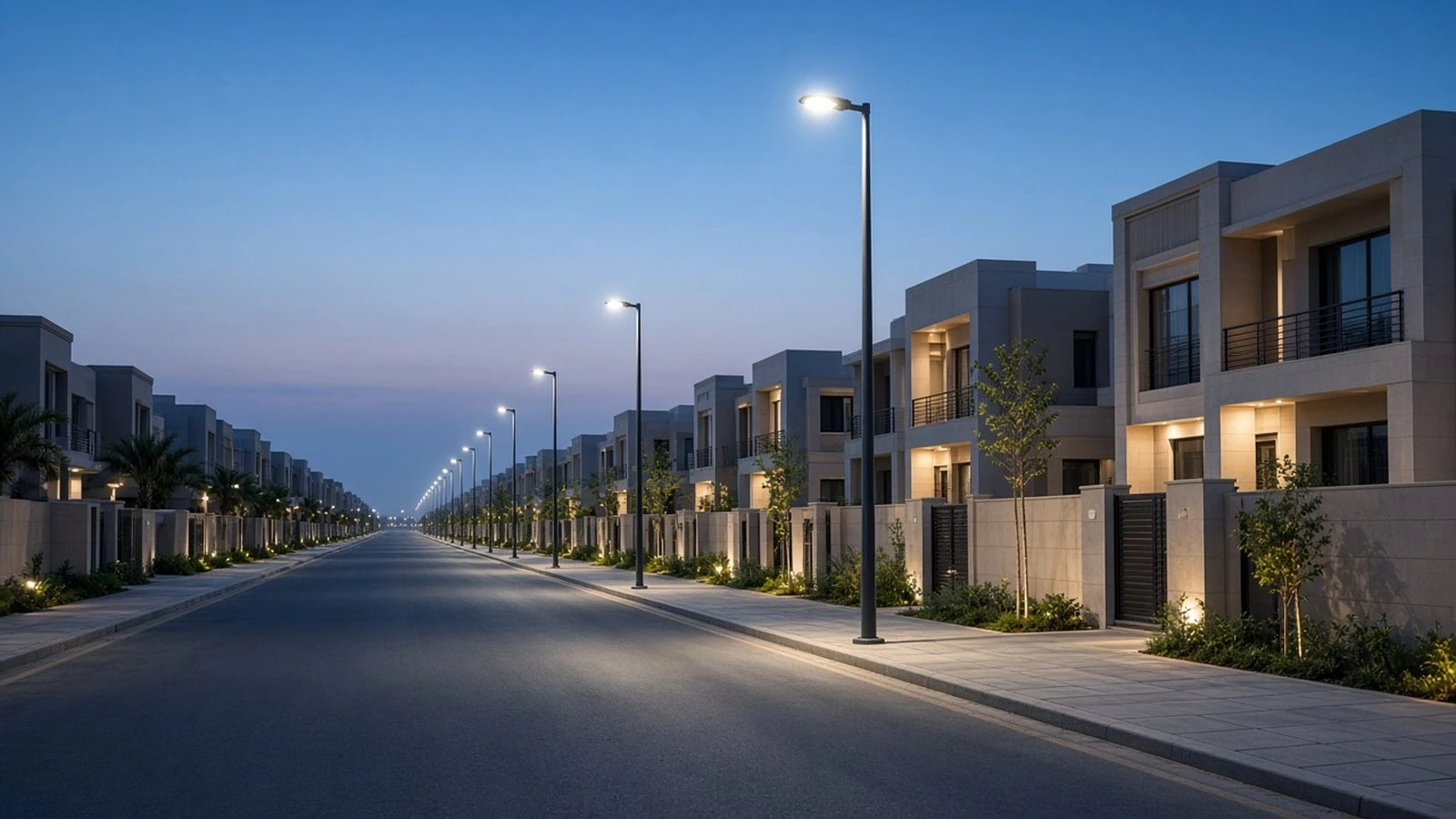
Good street lighting is one of the first things residents notice in a new neighborhood. It makes walking in the evening safer and more pleasant, helps drivers see pedestrians and junctions, and contributes to a sense of security. In Saudi cities, where much outdoor activity takes place after sunset, especially in the hot months, street lighting is an essential part of the infrastructure package for any residential subdivision. Planning it at the design stage, alongside roads and other utilities, avoids costly retrofits and the visual clutter of poorly placed poles.
Design Criteria and Lighting Layout
The design follows the requirements of the municipality and the electricity provider, starting with the classification of each road in the subdivision. Main collector roads carry more traffic and need higher lighting levels and uniformity than quiet local streets or pedestrian paths. For each road class, the lighting engineer selects target illuminance and uniformity values, then uses photometric calculations to determine the layout. Key decisions include:
- Pole height and spacing, balanced so that light is even along the road without dark patches between poles.
- Arrangement on one side, both sides, or the central median, depending on road width and the location of other utilities.
- Energy-efficient LED luminaires with suitable optics that direct light onto the road and sidewalks rather than into homes or the sky.
- Extra attention at junctions, roundabouts, crossings, and parks, where pedestrians and vehicles meet.
Choosing a suitable color temperature and limiting glare improves visual comfort for residents and drivers alike, while reducing light spill into bedrooms and private gardens.
Power, Control and Coordination with Other Utilities
Behind every pole is a network of cables, feeder pillars, and control equipment. The electrical design sizes cables for voltage drop over long runs, protects circuits properly, and provides reliable earthing, especially important for metal poles in public spaces. Control systems such as photocells or astronomical timers switch lights on and off automatically, and smart controls can dim lighting during late-night hours to save energy. Coordination with other underground services is essential: cable routes, pole foundations, and feeder pillars must be placed to avoid conflicts with water, sewer, telecommunications, and stormwater networks, and to respect required separation distances. Poles should also be positioned so they do not obstruct driveways, sidewalks, or sight lines at junctions. During construction, supervision covers foundation dimensions, cable depth and protection, insulation resistance testing, and final lighting measurements against the design. Finally, a maintenance plan for cleaning luminaires, replacing faulty units, and inspecting poles keeps the network performing well, so the neighborhood stays safe and welcoming after dark for years to come.